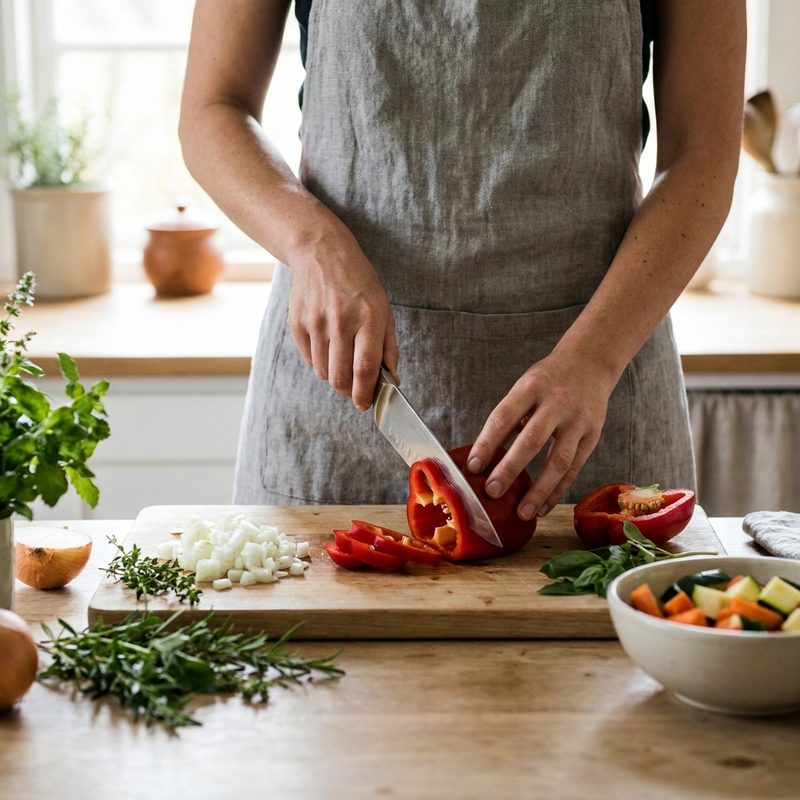
Step 1: Mastering the Pinch Grip
The foundation of good knife work starts with how you hold the tool. Instead of gripping the handle like a hammer, use the 'pinch grip.' Place your thumb and index finger on opposite sides of the blade just above the handle, where the metal meets the bolster. Wrap your remaining three fingers around the handle. This grip provides superior control and balance, allowing the knife to become an extension of your arm.
Step 2: The Guide Hand (The Claw)
Safety is paramount, and your non-cutting hand determines how safe you are. Form a 'claw' by tucking your fingertips inward toward your palm. Rest your knuckles against the side of the knife blade as a guide. This technique ensures that your fingertips are always tucked away from the sharp edge, while your knuckles act as a buffer to control the thickness of your slices.
Step 3: The Rocking Motion
For most vegetables, the rocking motion is the most efficient technique. Keep the tip of the knife in contact with the cutting board. Lift the handle and heel of the knife, then push forward and down through the ingredient. This rhythmic motion creates clean, precise cuts with minimal effort. Avoid 'chopping' or 'hacking' straight down, which can dull the blade and lead to uneven pieces.
Step 4: Executing Basic Cuts
Once you are comfortable with the grip and motion, practice three core cuts. The Julienne involves cutting vegetables into thin, matchstick-like strips. The Dice starts with julienne strips that are then turned 90 degrees and cut into uniform cubes. Finally, the Chiffonade is used for leafy greens and herbs; stack the leaves, roll them into a tight cigar shape, and slice crosswise into thin ribbons.
Step 5: Knife Maintenance and Safety
A dull knife is more dangerous than a sharp one because it requires more force and is more likely to slip. Always hand-wash your knives with warm, soapy water and dry them immediately. Never put high-quality knives in the dishwasher, as the heat and chemicals can damage the blade and handle. Use a honing rod regularly to keep the edge aligned between professional sharpenings.
Key Takeaways
- ✓ <ul><li>Stabilize your cutting board by placing a damp paper towel or a thin silicone mat underneath it to prevent slipping.</li><li>Let the weight of the knife do the work; if you find yourself pressing down hard, your knife likely needs sharpening.</li><li>Cut a small slice off round vegetables (like potatoes or onions) to create a flat, stable surface before you begin dicing.</li><li>Focus on consistency and technique first; speed will come naturally with practice.</li></ul>