Step 1: Establishing a Secure Grip and Stance
Before you even touch a vegetable, you must master the 'pinch grip.' Hold the handle of your chef's knife with your middle, ring, and pinky fingers. Use your thumb and index finger to pinch the blade itself just above the handle (the bolster). This provides maximum control and prevents the knife from wobbling. Stand with your feet shoulder-width apart and keep your guide hand in a 'claw' position, tucking your fingertips inward to protect them from the blade.
Step 2: Squaring Off the Vegetable
Safety and precision start with stability. Most vegetables are round, which makes them prone to rolling. To prevent this, slice a thin strip off one side of the vegetable (like a carrot or potato) to create a flat base. Rest the vegetable on this flat surface. Next, trim the ends and the remaining sides to create a rectangular 'block' or 'plank.' These scraps can be saved for stocks or soups.
Step 3: The Julienne Cut (Matchsticks)
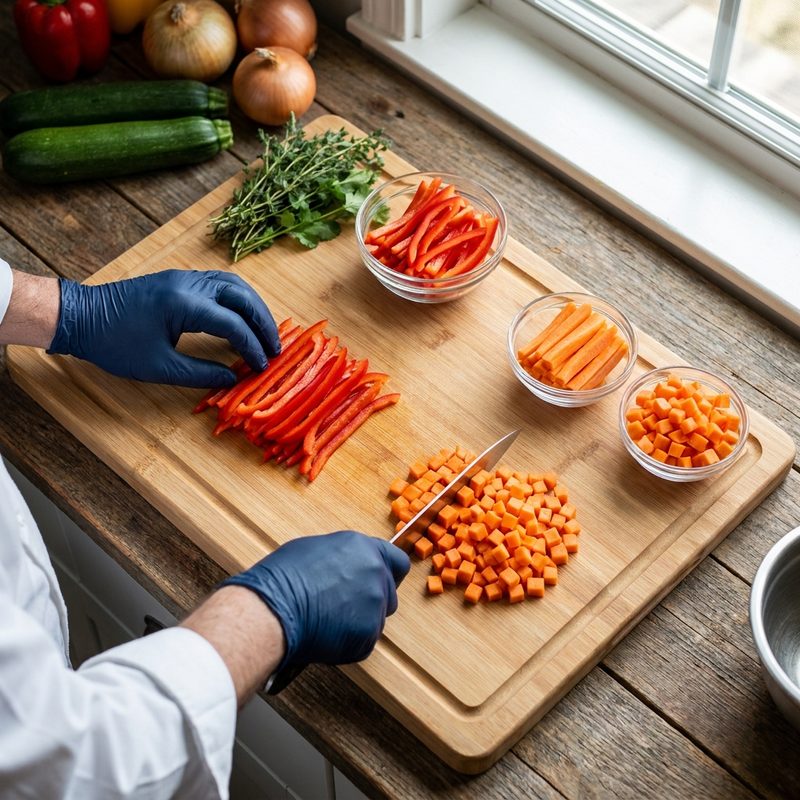
To julienne, take your rectangular block and cut it lengthwise into thin, even slices about 1/8 inch thick. These are often called 'planks.' Stack two or three planks on top of each other and cut them lengthwise again into thin strips of the same 1/8 inch width. The result should be uniform matchsticks, typically 2 to 2.5 inches long. For a slightly thicker version, known as a 'batonnet,' aim for 1/4 inch dimensions.
Step 4: The Dice (From Julienne to Cubes)
Dicing is simply the next step after the julienne. Take your bundle of julienned strips and line them up horizontally on the cutting board. Cut crosswise at even intervals (1/8 inch for a 'brunoise' or 1/4 inch for a 'small dice'). By maintaining the same width as your julienne cut, you ensure perfectly cubic shapes. For a medium dice, start with 1/2 inch planks and strips.
Step 5: The Finishing Motion
Use a fluid rocking motion or a smooth 'locomotive' push-cut rather than a vertical chopping motion. Keep the tip of the knife in contact with the board as much as possible for stability. This technique reduces fatigue and ensures that each cut is clean and complete, preventing 'accordion' vegetables that are still attached at the bottom.
Key Takeaways
- ✓ <html><ul><li>Always use a sharp knife; a dull blade is more likely to slip and cause injury.</li><li>Stabilize your cutting board by placing a damp paper towel or a silicone mat underneath it.</li><li>Uniformity isn't just for aesthetics; vegetables cut to the same size will cook at the same rate.</li><li>Save the 'trimmings' from your squaring process in a freezer bag to make homemade vegetable stock later.</li><li>Practice on soft vegetables like zucchini before moving on to harder root vegetables like carrots or parsnips.</li></ul></html>