Understanding the Science of Emulsion
An emulsion occurs when two immiscible liquids, such as oil and vinegar, are forced together so that one is dispersed as tiny droplets throughout the other. Without an emulsifier, these liquids will eventually separate. To create a stable sauce, you need an emulsifying agent like mustard, egg yolks, or honey, which contains molecules that are attracted to both water and fat, holding them together.
The Importance of Temperature
For most emulsions, particularly those involving egg yolks like mayonnaise or hollandaise, room temperature ingredients are essential. If your oil is cold or your base is too hot, the proteins in the emulsifier won't be able to properly bond with the fat, leading to a thin or broken sauce. Ensure your eggs and acids are at room temperature before beginning.
Step 1: The Slow Incorporation Method
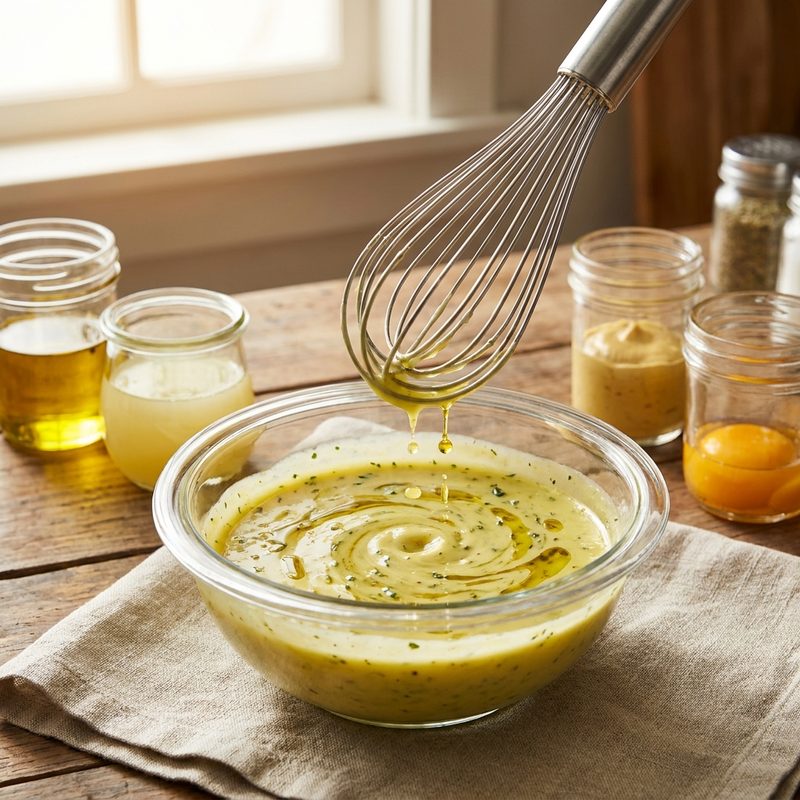
Begin by placing your water-based liquid (vinegar, lemon juice, or water) and your emulsifier (mustard or egg yolk) in a bowl. Whisk them together until combined. The key to a successful emulsion is the 'slow stream' technique. Slowly—literally drop by drop at first—whisk in your oil. If you see the oil pooling on the surface, stop adding oil and whisk vigorously until it disappears before adding more.
Step 2: Using Mechanical Power
While a whisk works well for small batches, a blender or immersion blender provides the high-speed shear needed for a rock-solid emulsion. When using an immersion blender for mayonnaise, place all ingredients in a narrow jar, let them settle, and then pulse at the very bottom. As the white emulsion forms, slowly pull the blender upward to incorporate the remaining oil.
Step 3: Adjusting Consistency and Seasoning
Once your emulsion is stable and thick, taste it. Emulsions often dull the perception of salt and acid, so you may need more seasoning than you expect. If the sauce is too thick, whisk in a teaspoon of warm water or lemon juice to thin it to your desired consistency. Always season at the very end to ensure the flavors are balanced.
How to Fix a Broken Sauce
If your sauce separates and looks curdled, do not throw it away. To fix it, place a teaspoon of your base liquid (water or lemon juice) or a fresh egg yolk in a clean bowl. Very slowly, whisk the broken sauce into the new base, treat it as if it were pure oil. This will re-establish the bond and save your ingredients.
Key Takeaways
- ✓ <html><ul><li>Always use a ratio of 3 parts oil to 1 part acid for a standard balanced vinaigrette.</li><li>Add a teaspoon of Dijon mustard to any dressing; it is one of the most effective natural emulsifiers available.</li><li>Use a damp kitchen towel rolled into a 'nest' or ring around the base of your bowl to keep it stable while you whisk with one hand and pour oil with the other.</li><li>For the smoothest texture, strain your final sauce through a fine-mesh sieve to remove any small clumps of emulsifier or herbs.</li></ul></html>