Understanding the Science of Doneness
Cooking meat to the correct internal temperature is the only reliable way to ensure food safety while preserving moisture and flavor. Relying on visual cues like color or the finger test is often inaccurate because factors like pH levels and lighting can be deceptive. A digital instant-read thermometer is your most important tool in the kitchen for consistent results.
How to Properly Measure Temperature
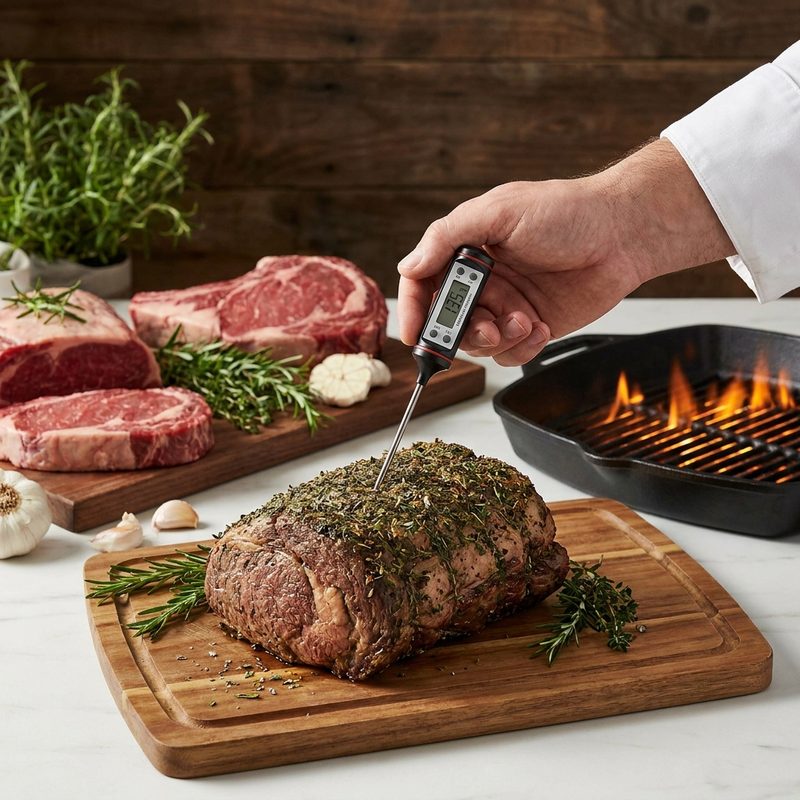
To get an accurate reading, insert your thermometer into the thickest part of the meat, avoiding any bone, fat, or gristle, which can conduct heat differently than the muscle. For poultry, the best spot is the thickest part of the thigh, making sure not to hit the bone. For steaks or chops, insert the probe horizontally into the side to ensure the sensor is fully submerged in the center of the cut.
Master Temperature Chart
For poultry, the USDA recommends a minimum of 165°F (74°C). For ground meats like beef, pork, and lamb, aim for 160°F (71°C). Whole cuts of beef, lamb, and veal can be cooked to 145°F (63°C) for medium-rare, while pork is now safely enjoyed at a juicy 145°F (63°C) followed by a three-minute rest. Finfish should reach 145°F (63°C) or until the flesh is opaque and separates easily with a fork.
The Importance of Carryover Cooking
It is crucial to remove your meat from the heat source when it is 3 to 5 degrees below your target temperature. This is because carryover cooking occurs while the meat rests; the internal temperature will continue to rise as heat moves from the exterior to the cooler center. Ignoring this phase often leads to overcooked, dry results.
Key Takeaways
- ✓ <html><ul><li>Always calibrate your thermometer in an ice-water bath regularly to ensure accuracy.</li><li>Rest your meat for at least 5-10 minutes (longer for large roasts) to allow juices to redistribute.</li><li>Clean your thermometer probe with hot, soapy water after every use to prevent cross-contamination.</li><li>Invest in a digital instant-read thermometer for the fastest and most precise readings compared to analog dials.</li></ul></html>