The Anatomy of a Starch Granule
To understand thickening, you must first understand the starch granule. Starch is composed of two carbohydrate molecules: amylose (long, linear chains) and amylopectin (highly branched chains). These are packed tightly into semi-crystalline granules. In their raw state, these granules are insoluble in cold water; they simply sink to the bottom of the pot without interacting with the liquid.
The Process of Gelatinization
When you apply heat to a mixture of starch and liquid, the kinetic energy causes the starch granules to vibrate and expand. As the temperature reaches a critical point (usually between 140°F and 175°F for wheat flour), the granules begin to absorb water like tiny sponges. This absorption forces the amylose and amylopectin chains apart, causing the granules to swell to many times their original size. This stage is known as swelling, and it is the first step toward a thick sauce.
The Burst and the Web
As heating continues, the granules eventually reach their maximum capacity and burst. This releases the long-chain amylose molecules into the surrounding liquid. Once free, these molecules collide and entangle with one another, creating a complex three-dimensional web. This molecular net traps water molecules in place, reducing their ability to flow freely. This loss of mobility is exactly what we perceive as the 'thickening' of a gravy or sauce.
Dispersion: The Key to Smoothness
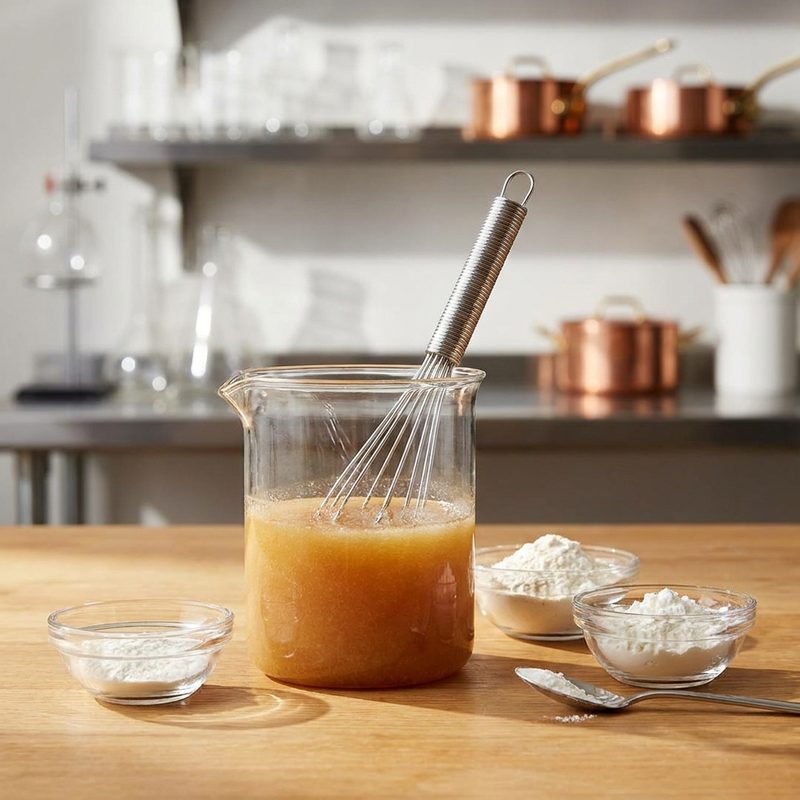
A common culinary failure is the 'lumpy' sauce. This happens when starch is added directly to hot liquid. The granules on the outside of a clump gelatinize instantly, creating a waterproof seal that prevents the interior granules from hydrating. To prevent this, chefs use a roux (cooking starch in fat) or a slurry (mixing starch with cold liquid). Both methods ensure that starch granules are physically separated before they begin to swell, allowing for even gelatinization throughout the entire pot.
Key Takeaways
- ✓ <html><ul><li><b>Don't skip the simmer:</b> Always simmer a thickened sauce for at least 1-2 minutes to 'cook out' the raw flour taste and ensure the starch network is fully set.</li><li><b>Acid Timing:</b> Add acidic ingredients like lemon juice or vinegar after the sauce has thickened; acid can break down starch chains (hydrolysis) if cooked too long, thinning the sauce.</li><li><b>Vigorous Whisking:</b> Whisking doesn't just prevent lumps; it helps distribute the bursting amylose molecules more evenly for a consistent texture.</li><li><b>Avoid Over-stirring:</b> While whisking is good initially, excessive mechanical shearing after the sauce has thickened can actually break the starch chains and cause the sauce to thin out again.</li></ul></html>