Understanding the Goal: Flavor Foundation vs. Browning
While sauteing relies on high heat to trigger the Maillard reaction and create browned, nutty flavors, sweating is all about gentle extraction. The goal is to soften the cell walls of vegetables like onions, leeks, and celery, allowing them to release their natural juices and sweeten without caramelizing. This is crucial for white sauces, light soups, and risottos where you want the pure essence of the vegetable without the bitterness or color of charred bits.
Step 1: Choose Your Fat and Prep Your Pan
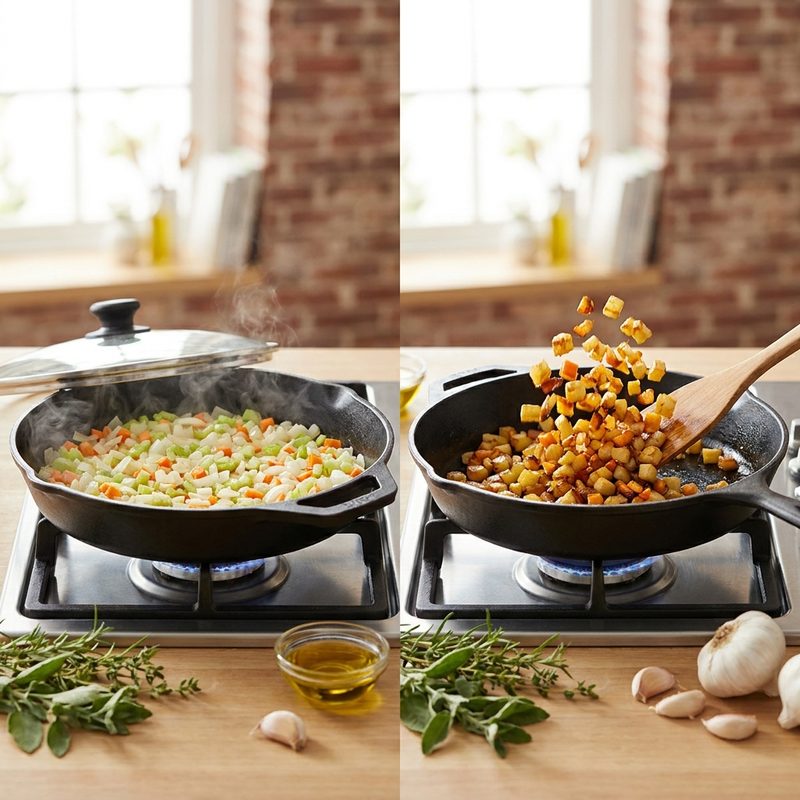
Start with a heavy-bottomed pan to ensure even heat distribution. Add a tablespoon of fat—butter is classic for its flavor, but olive oil or neutral oils work well too. Place the pan over low to medium-low heat. You want the fat to melt or shimmer, but it should never smoke or sizzle loudly when the vegetables are added.
Step 2: The Importance of a Pinch of Salt
Once you add your finely diced aromatics (the mirepoix or holy trinity), sprinkle them with a pinch of salt immediately. Salt is hygroscopic, meaning it draws moisture out of the vegetables through osmosis. This moisture prevents the vegetables from frying and instead allows them to cook in their own released liquid, effectively sweating.
Step 3: Controlling Heat and Using a Lid
The key to successful sweating is patience. Maintain a very gentle sizzle—so quiet you can barely hear it. To speed up the process while keeping the temperature low, you can place a lid or a cartouche (a circle of parchment paper) directly over the vegetables. This traps the steam, ensuring they soften uniformly and stay moist.
Step 4: Identifying Done-ness
Sweating is complete when your aromatics are translucent, soft to the touch, and highly fragrant. Onions should look glassy rather than white, and there should be no golden-brown edges. This usually takes between 5 to 10 minutes depending on the volume of vegetables.
Key Takeaways
- ✓ <html><ul><li>Use a heavy-bottomed pan like a Dutch oven to prevent hot spots that cause premature browning.</li><li>Cut your vegetables into uniform sizes to ensure they all finish sweating at the same time.</li><li>If the vegetables start to brown, add a teaspoon of water or stock to instantly lower the pan temperature.</li><li>Don't walk away; sweating requires frequent stirring to distribute heat evenly and prevent sticking.</li></ul></html>