Cool Before Storing
One of the most critical steps in bread storage begins the moment the loaf leaves the oven. According to storage testing by experts at King Arthur Baking, bread must be allowed to cool completely before it is wrapped or placed in a storage container. If you wrap a warm loaf, the residual heat creates steam, which becomes trapped against the bread. This moisture leads to a soggy crust and creates a damp environment that encourages rapid mold growth. For the best results, place your loaf on a wire cooling rack to allow air to circulate around all sides, including the bottom. Only once the loaf has reached room temperature should you consider your long-term storage options.
Identify Soft versus Crusty Bread
The method you choose for storage should depend heavily on the type of bread you are handling. Soft, enriched breads—such as sandwich loaves, brioche, or rolls—contain fats and sugars that help them stay moist. These breads generally fare well in airtight environments like plastic bags, which keep the crumb soft. On the other hand, crusty artisan breads, like baguettes or sourdough, rely on a specific moisture gradient. Their charm lies in the contrast between a crackly exterior and a chewy interior. Using airtight plastic on these loaves will quickly migrate moisture from the crumb to the crust, leaving the entire loaf soft and leathery. Recognizing the structural needs of your specific loaf is the first step in successful preservation.
Same-Day Storage
If you plan to consume your bread within 24 hours, the best storage method is often the simplest. King Arthur Baking suggests that a large, crusty loaf can actually sit on a cutting board, cut-side down and unwrapped, for roughly a day. This technique uses the cutting board to seal the exposed interior from the air, preventing it from drying out, while the rest of the crust remains exposed to the air to maintain its crispness. This is the ideal solution for high-quality artisan boules that you intend to serve throughout the day. For soft sandwich breads, keeping them in their original packaging or a simple bread box at room temperature is sufficient for the first day of freshness.
Wrapping Tradeoffs
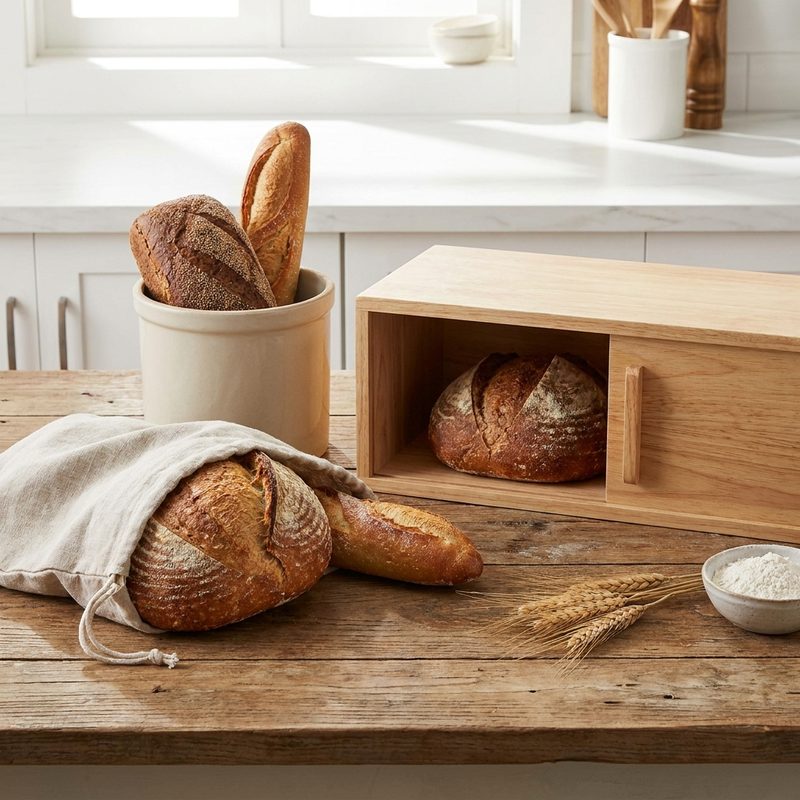
Choosing the right wrapping material involves a trade-off between moisture retention and texture. King Arthur’s testing explains that airtight plastic or foil is excellent for retaining crumb moisture, but these materials will inevitably soften a crisp, artisan crust. If you prefer a soft loaf, plastic is your best friend. If you want to preserve a crusty exterior, paper bags are a better middle ground; they allow the bread to breathe slightly, though the bread will go stale faster than it would in plastic. For those who want the best of both worlds, a cloth bread bag or a specialized bread box can provide a regulated environment that manages moisture without making the crust completely soggy.
Storing a Cut Loaf
Once a loaf is sliced, the clock begins to tick much faster. The exposed surface area allows moisture to escape rapidly, leading to staling. When storing a partially eaten loaf at room temperature, always try to minimize the surface area exposed to the air. In addition to the cut-side down method for crusty breads, you can also push the two cut ends of a loaf back together before wrapping it. If you are using a plastic bag for a soft loaf, ensure you squeeze out as much air as possible before sealing. As a general planning estimate provided by Utah State Extension, fresh purchased bread can typically last about five days at 70°F when kept in its original container; however, this is a quality estimate rather than a safety deadline, as factors like local humidity and the specific ingredients in the bread can cause results to vary.
Freezing
For any bread that will not be eaten within a few days, both King Arthur Baking and Penn State Extension strongly recommend freezing as the superior long-term storage solution. Freezing effectively pauses the staling process. To freeze correctly, ensure the bread is completely cool, then wrap it tightly. King Arthur’s freezing guide emphasizes that airtight storage is vital to prevent the bread from absorbing freezer odors and to stop it from drying out. You can freeze whole loaves, but many find it more convenient to slice the bread first and place parchment paper between the slices. This allows you to remove only what you need, reducing waste and keeping the rest of the loaf protected.
Thawing and Refreshing
Properly frozen bread can be brought back to life with excellent results. For individual slices, a toaster is the most efficient method, as it thaws and crisps the bread simultaneously. For a whole loaf, let it thaw at room temperature while still in its wrapping to allow it to reabsorb any moisture that migrated to the surface. To restore a "just-baked" texture to a crusty loaf, you can lightly mist the thawed crust with water and place it in a 350°F oven for 5 to 10 minutes. This process re-gelatinizes the starches in the crumb and recrisps the crust, making the bread taste nearly as good as the day it was made.
Refrigeration Tradeoffs
While it might seem intuitive to put bread in the refrigerator to keep it fresh, this is often a mistake. King Arthur explains that ordinary refrigeration actually speeds up the staling process through a phenomenon called starch retrogradation, where moisture leaves the starch molecules and migrates to the interstitial spaces. This results in a firm, dry, and crumbly texture. However, there is one major exception: if you live in a very hot and humid climate, a kitchen may become an incubator for mold. In these specific cases, King Arthur notes that refrigeration may be justified to slow down mold growth if freezing the bread is not a practical option for your current needs.
Mold Warning Signs
Because bread is a moist, starch-rich environment, it is highly susceptible to mold, especially in warm conditions. Always inspect your bread before consumption. Look for fuzzy patches that may be green, white, black, or blue. It is important to note that if you see mold on one part of a sliced loaf, the microscopic hyphae (roots) have likely spread throughout the entire bag, meaning the whole loaf should be discarded. Be particularly vigilant with homemade breads, which lack the preservatives found in many commercial varieties. Smelling the bread is also helpful; a sour or fermented odor that wasn't there before is a clear indicator that the bread is past its prime.
Quick Decision Guide
To summarize your storage strategy: if you are eating it today, leave crusty bread cut-side down on a board and soft bread in a bag. If you are eating it within two to three days, a bread box or paper bag works best for crusty loaves, while plastic is best for soft ones. For anything beyond three days, wrap the bread in airtight packaging and move it to the freezer. Avoid the refrigerator unless the heat and humidity of your kitchen make mold an immediate threat. Following these simple rules will ensure that every slice of bread you enjoy is of the highest possible quality.
Sources
King Arthur Baking: The Best Way to Store Yeast Bread
King Arthur Baking: How to Freeze Bread
Penn State Extension: Reducing Food Waste
Utah State Extension: Food Storage in the Home
Key Takeaways
- ✓ <html><ul><li>Never wrap bread while it is still warm to avoid a soggy crust and mold.</li><li>For crusty loaves, store them cut-side down on a cutting board to keep them fresh for 24 hours.</li><li>Use the freezer for long-term storage; it stops the staling process better than any other method.</li><li>Avoid the refrigerator for bread, as the cold temperature actually causes it to go stale faster.</li><li>Mist a day-old crusty loaf with water and pop it in the oven for a few minutes to restore its crunch.</li></ul></html>