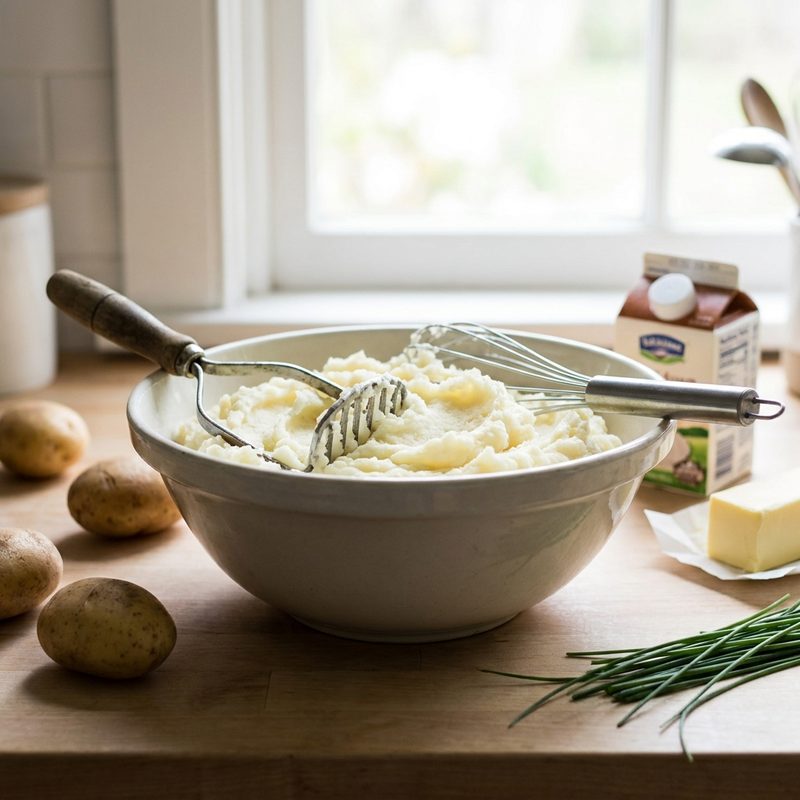
Step 1: Select the Right Potato
For the best texture, choose starchy potatoes like Russets or semi-starchy varieties like Yukon Golds. Russets provide a light, fluffy mash because they break down easily, while Yukon Golds offer a natural buttery flavor and a creamier, denser consistency. Avoid waxy potatoes such as Red Bliss or Fingerlings, which hold their shape and yield a gluey, sticky mash. If you want the fluffiest possible result, go with Russets — their starch content is around 20%, which gives that cloud-like texture. Yukon Golds, at about 16% starch, produce a richer, almost velvety mash that holds up better to gravy. For a hybrid, use a 50/50 blend of Russets and Yukon Golds. Always inspect potatoes for green patches or sprouts, which indicate solanine and can impart bitterness; cut away any damaged areas before cooking.
Step 2: Cold Water Start and Uniform Cutting
Peel your potatoes and cut them into uniform 1.5-inch chunks to ensure even cooking. A 1.5-inch cube is roughly the size of a walnut — too small and they waterlog; too large and the exterior overcooks before the center softens. Use a sharp chef's knife and a steady hand; uneven pieces mean some chunks will be mushy while others remain crunchy. Always start them in a pot of cold, heavily salted water — use 1 tablespoon of kosher salt per quart of water. The salt seasons the potatoes from within and raises the boiling point slightly. Starting in hot water leads to an uneven cook where the outside turns to mush before the inside is tender. The water should cover the potatoes by at least 1 inch; if it doesn't, add more cold water. If you're short on time, you can use warm water, but never boiling — the starch on the surface will gelatinize prematurely, creating a barrier that slows heat penetration.
Step 3: Simmer Until Fork-Tender
Bring the water to a boil over high heat — you'll see large, rolling bubbles and hear a vigorous churning sound. As soon as it boils, reduce the heat to medium-low so the water settles into a gentle simmer: small bubbles rising lazily, the surface barely trembling. A full boil can cause the potato chunks to bump against each other and break apart, releasing starch into the water and making the mash gummy. Cook the potatoes until they are completely tender throughout. This typically takes 15 to 20 minutes from the start of the simmer, depending on chunk size. You should be able to pierce a chunk with a fork or knife with zero resistance — the utensil should slide in like it's entering room-temperature butter, and the potato should fall off the fork when lifted. If there's any resistance, cook 2 minutes more and test again. Overcooking leads to waterlogged potatoes that produce a thin, soupy mash; undercooking leaves hard, gritty bits. Drain them thoroughly in a colander — shake the colander vigorously to remove as much water as possible. Do not rinse the potatoes; you want the starch on the surface to help thicken the mash.
Step 4: Dry the Potatoes
Excess moisture is the enemy of flavorful mash. After draining, return the potatoes to the hot, empty pot over low heat for 1-2 minutes. Shake the pot gently to allow steam to escape; you'll see wisps of vapor rising and hear a faint sizzle as residual water evaporates. The potatoes should look slightly matte and feel dry to the touch — if they still glisten, give them another 30 seconds. This step ensures the potatoes will better absorb the butter and cream later. If you skip it, the added fat and liquid will pool on the surface rather than emulsifying into the starch, leaving you with greasy, separated mash. For extra drying, spread the potatoes in a single layer on a baking sheet and place in a 200°F oven for 5 minutes — this also keeps them hot while you prepare the aromatics.
Step 5: Choose Your Mashing Tool
For a rustic mash with small lumps and a hearty texture, use a standard wire masher — press down firmly and evenly, using a rocking motion to break up the chunks. For professional, silky-smooth results, use a potato ricer or a food mill. A ricer extrudes the potatoes through small holes (typically 1/8 inch), producing a fine, even crumb with no lumps. A food mill works similarly but allows you to choose a disc size — medium (2mm) for a slightly coarser texture, fine (1mm) for ultra-smooth. Avoid using a food processor or blender, as the high-speed blades tear the starch molecules, resulting in a gluey, gummy texture. If you only have a hand mixer, use the lowest speed and stop the moment the potatoes are broken down — overmixing by even 10 seconds can trigger the glue effect. The same applies to a stand mixer: use the paddle attachment on low speed for no more than 30 seconds.
Step 6: Incorporate Warm Aromatics
Never add cold butter or milk to hot potatoes — cold fat seizes the starch, creating a lumpy, greasy mess. Heat your butter and milk (or cream) together in a small saucepan over medium-low heat until the butter is melted and the liquid is warm — about 130°F, or just below a simmer. You'll see the butter fully liquefy and the mixture become opaque; stir occasionally to prevent scorching. For every 2 pounds of potatoes, use 4 to 6 tablespoons of unsalted butter and 1/2 to 3/4 cup of whole milk or heavy cream. Heavy cream yields a richer, more decadent mash; whole milk gives a lighter texture. For a tangy twist, substitute buttermilk for half the milk — add it off the heat to avoid curdling. Slowly drizzle the warm liquid into the potatoes while folding gently with a rubber spatula or wooden spoon. Fold until just combined — stop when you see no dry streaks of starch. Overmixing at this stage also risks glueyness. Season with kosher salt and freshly ground white pepper (to avoid black specks) to taste — start with 1 teaspoon of salt and 1/4 teaspoon of pepper, then adjust. Taste and adjust: if the mash tastes flat, add another pinch of salt; if it's too salty, add a splash of warm milk. Serve immediately, or keep warm in a covered bowl set over a pot of simmering water for up to 30 minutes.
Key Takeaways
- ✓ <html><ul><li>Always salt your boiling water generously; this is your only chance to season the potato from the inside out.</li><li>Warm your dairy before adding it to prevent the potatoes from cooling down too quickly.</li><li>Avoid over-mixing; the more you work the potatoes, the more starch is released, which leads to a sticky consistency.</li><li>Add a clove of garlic to the boiling water for a subtle, infused garlic flavor without the bite of raw garlic.</li></ul></html>