The Molecular Structure of Eggs
Eggs are packed with proteins—primarily ovalbumin in the whites and various lipoproteins in the yolks. In their raw state, these proteins are tightly coiled like tiny springs. When heat is applied, these coils begin to unfold, a process known as denaturation. Once unfolded, they seek to bond with one another to create a solid structure. If they bond too quickly or at too high a temperature, they form tight, rubbery clumps, resulting in the dreaded scrambled egg texture in your sauce or custard.
Understanding the Coagulation Point
Egg proteins begin to coagulate at relatively low temperatures. Egg whites start setting at around 140°F (60°C), while yolks begin to thicken at 145°F (63°C). Most custards and sauces require liquids to be much hotter, often near the boiling point (212°F). Without tempering, the instant contact between the hot liquid and the raw egg causes the proteins to bond instantly into a solid mass. Tempering works by diluting the egg proteins and raising their temperature gradually, which increases the temperature threshold at which they will eventually coagulate.
The Role of Dilution and Interference
By whisking a small amount of hot liquid into the eggs first, you are doing more than just warming them. You are physically separating the egg proteins with molecules of water, fat, and sugar from the liquid. This interference makes it harder for the proteins to find each other and bond into clumps. This diluted mixture is much more resilient to heat, allowing it to be safely integrated back into the main pot of hot liquid without seizing.
Step-by-Step Tempering Technique
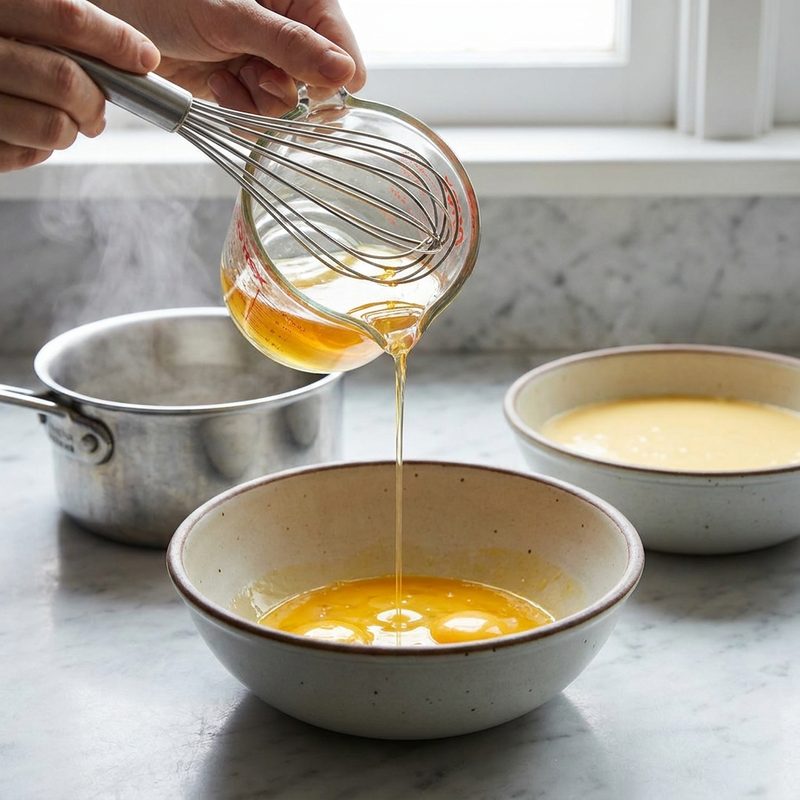
To temper correctly, begin by whisking your eggs or yolks in a heat-proof bowl. While whisking constantly, slowly drizzle a ladleful of the hot liquid into the eggs. The constant motion ensures no single part of the egg mixture stays in contact with the hot liquid for too long. Once the egg mixture feels warm to the touch and has been thinned out, you can slowly pour it back into the main pot, continuing to stir until the entire mixture reaches the desired thickness and the proteins form a smooth, continuous matrix.
Key Takeaways
- ✓ <html><ul><li>Always use a whisk, not a spoon, to ensure the hot liquid is instantly distributed and integrated.</li><li>Place a damp kitchen towel under your bowl to prevent it from sliding while you pour with one hand and whisk with the other.</li><li>If you notice tiny lumps forming, immediately pour the finished sauce through a fine-mesh sieve to restore a silky texture.</li><li>Adding sugar to the egg yolks before tempering raises the coagulation temperature even further, providing an extra safety net against curdling.</li></ul></html>