Step 1: Wash and Thoroughly Dry
Start by rinsing your cilantro under cold running water to remove any grit or sand. Submerge the bunch in a large bowl of cold water and swish vigorously for 10 seconds; lift it out and let the sediment settle at the bottom, then repeat with fresh water if you see any remaining dirt. The most important part of this step is drying: use a salad spinner and spin for at least 20 seconds, then dump out the water and spin again for another 10 seconds. Alternatively, pat the leaves dry with paper towels, pressing gently between two layers until no moisture remains. Wet cilantro will turn into a mushy paste rather than clean flakes when chopped—if you see water pooling on your cutting board after the first cut, stop and blot the leaves dry again with a fresh towel.
Step 2: Manage the Stems
Unlike parsley, cilantro stems are tender and packed with intense flavor. You do not need to pick every leaf off individual stems. Instead, gather the bundle and trim off only the thick, woody bottoms of the stems—cut about 1 to 2 inches from the root end, where the stems are pale and tough. Keep the upper, thinner stems to chop along with the leaves for added crunch and aroma. If you encounter any yellowing or wilted leaves, pinch them off and discard them now. For a milder flavor, you can remove the thicker central stems that are darker green and more fibrous, but this is optional—most recipes benefit from including them.
Step 3: Bundle and Roll
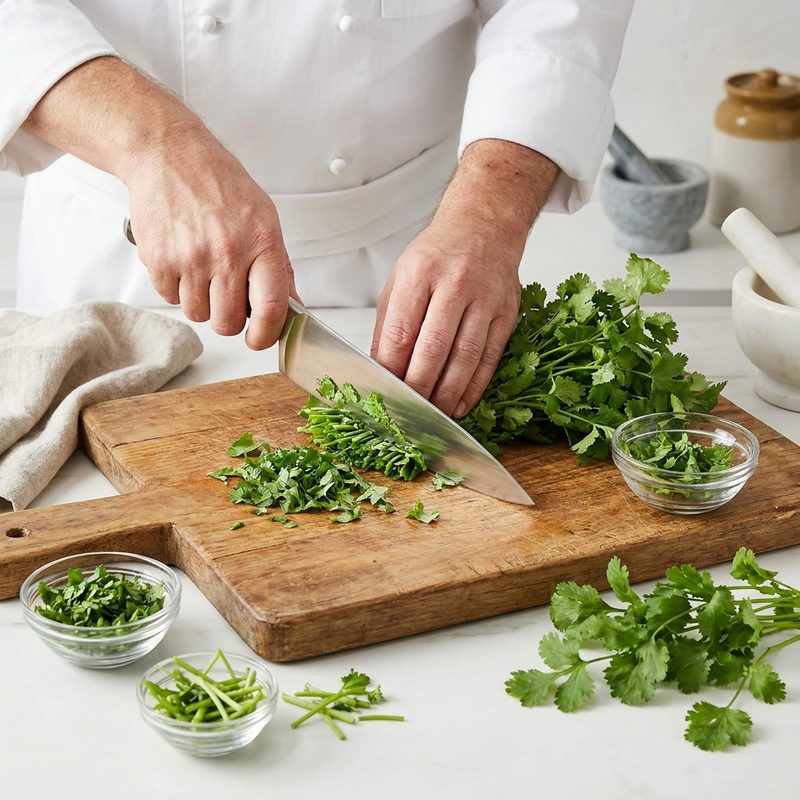
Gather the cilantro into a tight, compact ball or cylinder on your cutting board. Use your non-dominant hand to hold the bunch firmly, tucking your fingertips in (the 'claw' grip) to protect them from the blade. This compression allows for more uniform cuts. If the bunch is very large, divide it into two smaller bundles—each should be no wider than the length of your knife blade (about 6 to 8 inches). Press down gently but firmly so the leaves and stems are aligned in the same direction; if some leaves stick out at odd angles, tuck them under your palm before cutting.
Step 4: The Rocking Motion
Using a sharp chef's knife (an 8-inch blade is ideal), use a rocking motion to slice through the bundle. Keep the tip of the knife in contact with the cutting board and move the heel of the knife down through the herb. Slice through the bundle once to create thin ribbons about 1/8 to 1/4 inch wide. If your knife is dull, it will crush the leaves instead of cutting them cleanly—sharpen it on a honing steel or whetstone before starting. You should hear a clean, crisp slicing sound; if you hear a tearing or squishing noise, the blade is too dull. For the first pass, cut at a 45-degree angle relative to the bundle to maximize surface area contact. If the bundle starts to unravel, stop and re-roll it tightly before continuing.
Step 5: Final Cross-Chop
If you prefer a finer mince, rotate your cutting board 90 degrees or pile the ribbons back into a heap. Place your non-dominant hand flat on top of the knife's spine and rock the blade back and forth across the pile until you achieve your desired consistency—typically 1/8-inch pieces for most recipes. Use a 30-degree rocking arc, moving the knife from the tip to the heel in a continuous motion. Avoid over-chopping, as this can bruise the herb and cause it to lose its bright green color—stop as soon as the pieces are uniform and no large leaf sections remain. If you see any dark, wet patches on the leaves, you have chopped too long; next time, reduce the number of passes by half. For a garnish, stop after the first slicing step (Step 4) to keep larger, more attractive ribbons. For salsas or marinades, cross-chop for 10 to 15 seconds total. If the cilantro starts to clump together, it is either too wet (go back to Step 1) or you have overworked it—spread the pieces out on the board and let them air-dry for 30 seconds before using.
Key Takeaways
- ✓ <ul><li><strong>Sharpness Matters:</strong> Always use a very sharp knife; a dull blade crushes the cell walls of the cilantro, leading to rapid darkening and a bitter taste.</li><li><strong>Dryness is Key:</strong> If the cilantro is even slightly damp, it will stick to the knife and the board, making a fine mince impossible.</li><li><strong>Save the Stems:</strong> If you prefer to only use leaves for garnishing, save the stems for blending into marinades, pestos, or simmering in stocks.</li><li><strong>Chop Just Before Serving:</strong> Cilantro begins to oxidize and lose its aromatic oils immediately after cutting, so wait until the last minute for the best flavor.</li></ul>