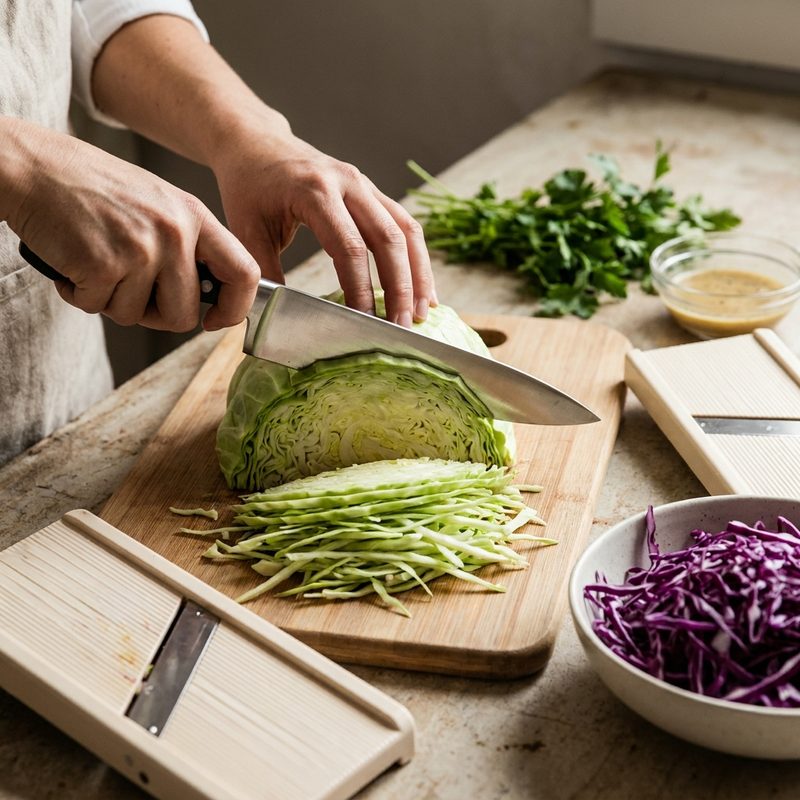
Step 1: Prep and Clean the Cabbage
Remove any wilted, damaged, or tough outer leaves from the cabbage head. Typically, peel off 2–3 layers until you reach leaves that are crisp, unblemished, and pale green or white. Rinse the cabbage under cold running water for 15–20 seconds, turning it to dislodge any dirt or grit trapped between the leaves. Pat it dry thoroughly with a clean kitchen towel—excess moisture will make shreds soggy and prevent dressing from clinging. Place the cabbage on a stable cutting board with a damp paper towel underneath to prevent slipping. If the cabbage feels loose or the leaves separate easily, it may be old; use it immediately for best texture.
Step 2: Halve and Quarter
Using a sharp chef's knife (8–10 inches is ideal), cut the cabbage in half through the stem end, applying steady pressure from the top down. You should hear a clean snap as the blade passes through the core. If the knife sticks, rock it gently back and forth rather than forcing it. Then, cut each half in half again, slicing through the stem at a 90-degree angle to create four quarters. Each quarter should be roughly equal in size, about 4–6 inches wide at the widest point. This makes the cabbage more manageable and exposes the core for easy removal. If the quarters wobble, trim a thin slice off the rounded side to create a flat, stable surface.
Step 3: Remove the Core
Identify the solid white core at the base of each quarter—it is a triangular, dense wedge about 1–2 inches long. Use your knife to cut into the cabbage at a 45-degree angle, making a V-shaped cut that removes the core in one piece. The cut should start about 1/2 inch from the base and angle inward to meet the opposite side. Discard the core or save it for vegetable stock (it adds mild sweetness). If you miss a piece of core, you will feel a hard, crunchy spot when chewing; simply trim it away. For very large cabbages, you may need to cut the core into two smaller pieces before removing.
Step 4: Shred with a Knife
Place one quarter flat-side down on the cutting board. Starting from the top (the leafy end) or the side (parallel to the core line), slice the cabbage into thin ribbons. For a fine shred, keep your slices 1/8 inch apart—about the thickness of a dime. For a coarser shred, space your cuts 1/4 to 1/2 inch apart. Use a claw grip with your non-dominant hand to hold the cabbage steady, curling your fingertips under so the knife blade slides against your knuckles. Apply even, smooth strokes; if the knife drags or tears, sharpen it. You should see uniform ribbons that separate easily. If shreds clump together, they are too thick or the cabbage is wet. For a 1-pound cabbage, this yields about 4–5 cups of shreds.
Step 5: Using a Mandoline (Optional)
For paper-thin, uniform shreds (1/16 inch or less), a mandoline is the best tool. Set the mandoline to your desired thickness—typically 1–2 mm for coleslaw. Hold a cabbage quarter firmly (using a hand guard for safety) and slide it across the blade in one smooth, continuous motion. Keep your fingers away from the blade at all times; the risk of cuts is high. This method is ideal for restaurant-style coleslaw where even cooking or dressing absorption is critical. If shreds are uneven, the blade may be dull or the cabbage piece is too large—cut it into smaller wedges. Clean the mandoline immediately after use to prevent rust.
Step 6: Using a Food Processor (Optional)
If you are processing a large volume of cabbage (more than 2 heads), use the slicing attachment of a food processor. Cut the cabbage into pieces small enough to fit through the feed tube—about 2–3 inches wide and 4–5 inches long. Pack them snugly but not too tightly; overfilling causes uneven shreds. Push them through while the machine is running for instant results. The shreds will be uniform, about 1/8 inch thick, and ready in seconds. For a finer texture, pulse the blade attachment instead, but be careful not to overprocess into mush. If the machine stalls, reduce the batch size. This method works best for coleslaw or stir-fries, but avoid for delicate dishes like cabbage rolls where texture matters.
Key Takeaways
- ✓ <html><ul><li>Use a very sharp knife to ensure clean cuts and prevent the cabbage from bruising.</li><li>If your cabbage feels a bit limp, soak the shredded pieces in a bowl of ice water for 15 minutes to restore the crunch.</li><li>To prevent red cabbage from bleeding its color, toss it with a little vinegar or lemon juice immediately after shredding.</li><li>Keep the root intact until you are ready to shred the final section to provide a better grip.</li></ul></html>