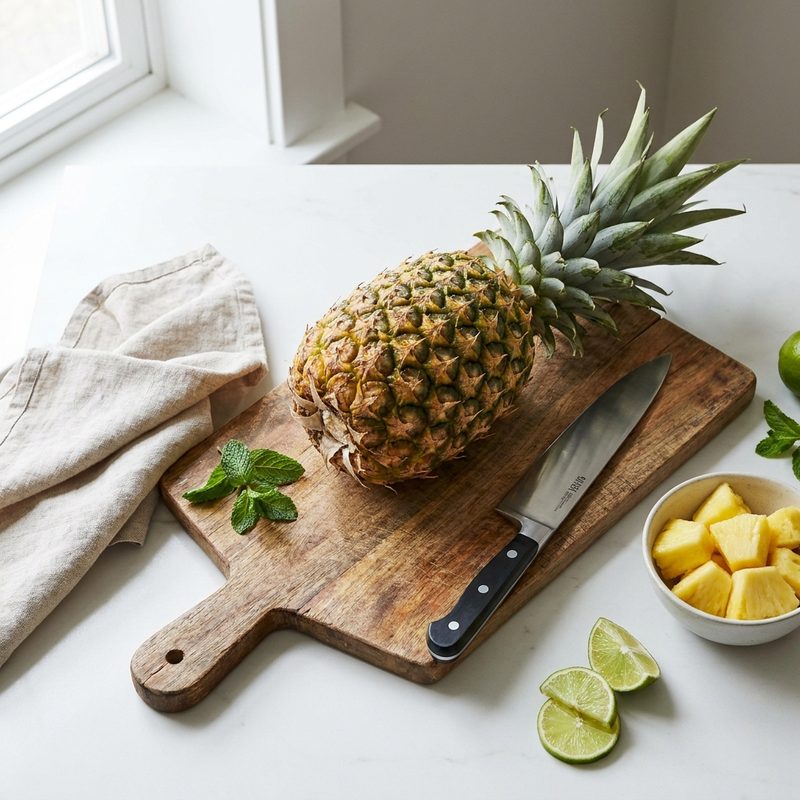
Origins and Selection
The pineapple (Ananas comosus) is native to South America, specifically the region between southern Brazil and Paraguay. When choosing a pineapple at the market, look for one that feels heavy for its size with vibrant green leaves. The most reliable indicator of ripeness is the scent; a ripe pineapple will have a sweet, tropical aroma at the base. Avoid fruits that smell fermented or have soft, dark spots on the skin.
Essential Tools and Preparation
Before you begin, ensure you have a sharp chef's knife and a stable, non-slip cutting board. Because pineapples are acidic, using a sharp blade is crucial to prevent bruising the flesh. Begin by laying the pineapple on its side and slicing off about a half-inch from the crown (the leafy top) and the base to create two flat surfaces.
Removing the Skin and Eyes
Stand the pineapple upright on its flat base. Following the natural curve of the fruit, slice downward to remove the skin in strips. Try to cut deep enough to remove most of the brown 'eyes,' but not so deep that you lose the sweetest outer flesh. Once the skin is removed, you may notice the eyes remain in diagonal rows. You can remove these by carving shallow diagonal V-shaped trenches along the rows, which preserves more fruit and creates a beautiful spiral pattern.
Coring and Final Cuts
To remove the fibrous core, slice the pineapple vertically into quarters. Stand each quarter up and slice away the woody center point. From here, you can slice the quarters into wedges or turn them horizontally to cut them into bite-sized chunks. For rings, keep the peeled pineapple whole and use a circular corer or a small round biscuit cutter after slicing into rounds.
Storage and Substitutes
Freshly cut pineapple should be stored in an airtight container in the refrigerator for up to 5 days. If you find yourself without pineapple, mango or papaya are excellent tropical substitutes in fresh applications, while peaches can work well in cooked or baked recipes. If you cannot find a fresh pineapple, high-quality frozen chunks are often superior to canned options as they lack the added heavy syrups.
Key Takeaways
- ✓ <html><ul><li><b>The Tug Test:</b> While not 100% foolproof, pulling a leaf from the center of the crown can indicate ripeness; if it slides out easily, the fruit is likely ready.</li><li><b>Don't Waste the Core:</b> Though tough, the core is full of fiber and bromelain. Chop it finely for smoothies or use it to infuse water and tea.</li><li><b>Avoid the Burn:</b> Pineapple contains bromelain, an enzyme that breaks down protein. If it makes your mouth tingle, try grilling the pineapple or soaking it in salt water briefly to neutralize the enzyme.</li><li><b>Maximize Juice:</b> If your pineapple is a bit firm, store it upside down on its crown for 24 hours before cutting to help the sugars redistribute.</li></ul></html>