Selecting Your Wok
When buying a wok, look for heavy-gauge carbon steel (at least 1.4mm to 2mm thick). Avoid non-stick coatings, as they cannot handle the high heat required for stir-frying and will degrade rapidly. A flat-bottom wok is best for modern electric and induction ranges, while round-bottom woks are superior for traditional gas burners equipped with a wok ring. For more detail, see our guide to season cast iron.
The Crucial First Scrub
New woks come coated in a factory-applied industrial oil to prevent rust during shipping. You must remove this entirely before seasoning. Use hot, soapy water and a stainless steel scrubber to vigorously wash the interior and exterior. This is the only time you should ever use soap and heavy abrasives on your carbon steel wok.
The Bluing Process
Place the clean, dry wok over high heat. As the metal heats up, it will turn yellow, then red, and finally a beautiful iridescent blue or silver-grey. This process, known as bluing, creates a protective oxide layer that helps the seasoning adhere. Rotate the wok constantly to ensure the sides are also heated until the color change is uniform across the entire surface.
Applying the Initial Seasoning
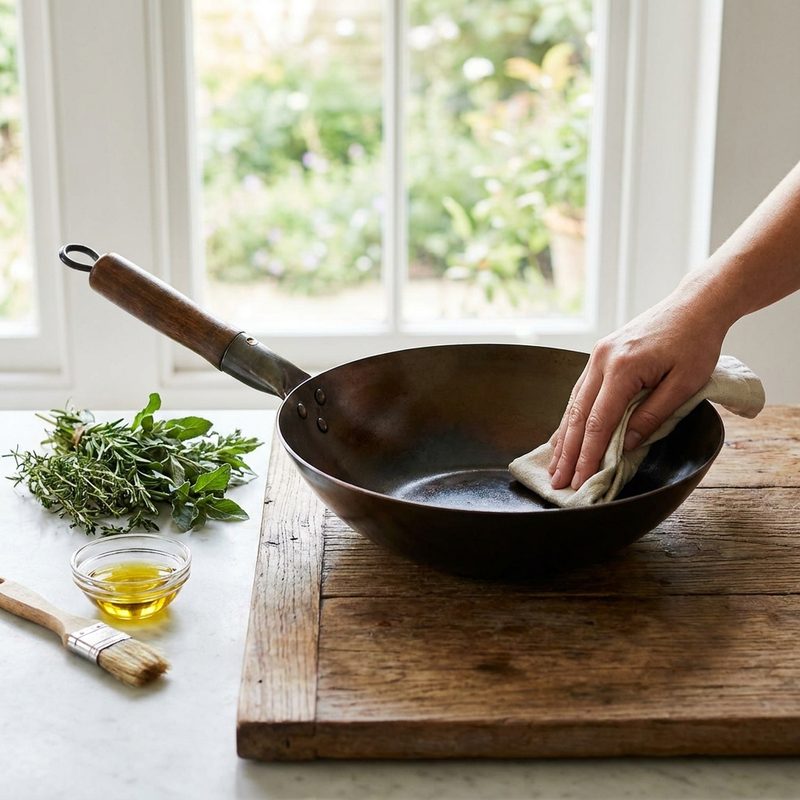
Turn off the heat and let the wok cool slightly. Apply a very thin layer of high-smoke point oil (like peanut, grapeseed, or canola) using a paper towel. Buff it until it looks like there is no oil left on the surface. Turn the heat back to medium-high until the wok begins to smoke. Repeat this process 2 to 3 times until the surface looks dark and semi-matte.
Aromatic Stir-Fry
To finish the seasoning and remove any remaining metallic taste, stir-fry a handful of pungent aromatics like ginger, scallions, or onions with a tablespoon of oil. Toss them around the entire surface for 5 to 10 minutes, then discard the aromatics. Rinse the wok with hot water (no soap) and dry it thoroughly on the stove.
Cleaning and Storage
After cooking, simply rinse the wok with hot water and a soft sponge or bamboo brush. Never put it in the dishwasher. Place it back on the stove over low heat to evaporate any moisture, then wipe with a tiny drop of oil before storing to prevent rust.
Key Takeaways
- ✓ <html><ul><li>Always use high smoke point oils; butter and extra virgin olive oil will burn and create a sticky, ineffective coating.</li><li>The secret to a perfect patina is 'thin is king'—too much oil results in a gummy, peeling surface rather than a hard non-stick layer.</li><li>If food begins to stick after some time, simply scrub the area with salt and oil, then re-apply a layer of seasoning over high heat.</li><li>The more you cook with your wok, the better the seasoning becomes. Frequent stir-frying is actually the best form of maintenance.</li></ul></html>