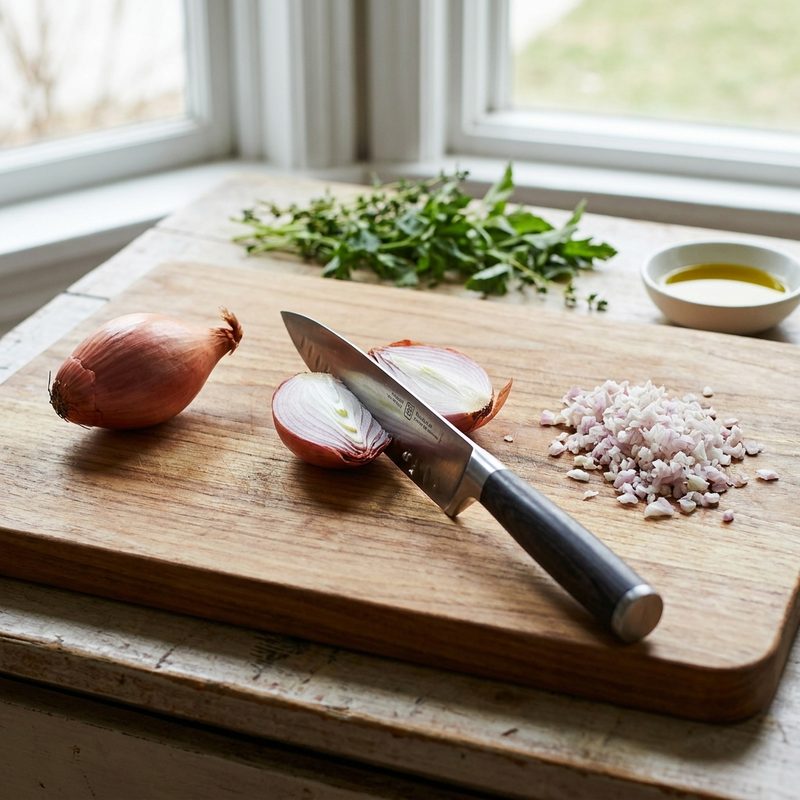
Step 1: Preparation and Trimming
Start by placing the shallot on a stable cutting board. Using a sharp chef's knife or paring knife, trim off the stem end while leaving the root end mostly intact. Leaving the root attached provides a handle that holds the layers together while you work, preventing the shallot from sliding apart. Choose a shallot that feels firm and heavy for its size, with no soft spots or green shoots. A standard shallot weighs about 30–50 grams. If the outer skin is very loose or papery, you may want to peel a bit before trimming. Keep the cutting board dry by wiping it with a damp cloth; a wet board can cause the shallot to slip. Angle the knife blade at about 45 degrees to the stem to make a clean cut, removing only 2–3 mm of the tip. If you accidentally cut into the root, the layers may separate later; in that case, hold the shallot together with your fingers as you work. For more detail, see our guide to sauté shallots.
Step 2: Peeling the Shallot
Cut the shallot in half lengthwise through the center of the root. This makes it much easier to peel away the papery outer skin and the first thin layer of flesh, which can often be tough or dry. Discard the skins and any dried membranes. Use your thumbnail or the tip of the paring knife to lift the skin from the cut edge. If the skin sticks, run the shallot half under cold water for 2–3 seconds to loosen it, then pat dry with a paper towel. For double-cone shallots (the most common variety), you may need to peel each half separately. The inner flesh should be pale purple or white; if you see green or black spots, trim them away as they indicate age or rot. After peeling, each half should be about 15–20 grams. If the shallot is very large (over 60 grams total), consider cutting it into quarters instead of halves for more even mincing.
Step 3: Making Vertical Slices
Place one half of the shallot flat-side down on the board. Position your knife tip near the root and make a series of thin, vertical slices moving toward the stem end. Be careful not to cut all the way through the root; keeping that base connected is the secret to a stable mince. Use a chef's knife with a blade length of 8–10 inches (20–25 cm) for best control. The slices should be 2–3 mm apart for a fine mince, or 4–5 mm for a coarse mince. Keep the knife blade perpendicular to the board (90 degrees) and use a rocking motion from the tip to the heel. You should hear a clean, crisp sound as the blade cuts through the layers; if you hear a tearing sound, the knife is dull. Your non-dominant hand should hold the shallot with fingertips curled under, knuckles against the blade. If the shallot starts to wobble, press it down more firmly with your palm. Aim for 8–12 vertical slices per half, depending on size. Stop slicing when you are about 5 mm from the root end; do not cut through it.
Step 4: Executing Horizontal Cuts
For an ultra-fine mince, make one or two horizontal cuts parallel to the cutting board, moving from the stem end toward the root. Keep your fingers flat on top of the shallot to stay safe. Again, do not cut through the root end. This creates a grid pattern within the shallot layers. The horizontal cuts should be 2–3 mm deep from the top surface. Use the tip of the knife to start the cut, then slide the blade forward while keeping it parallel to the board. If you have a very small shallot (under 20 grams per half), one horizontal cut is sufficient; for larger ones, two cuts spaced 3–4 mm apart work better. Keep your non-dominant hand flat on top of the shallot, with fingers spread to stabilize it. The knife should be sharp enough to slice through without crushing the layers; if you see bruising or juice leaking, the blade needs honing. After the horizontal cuts, the shallot should look like a tiny grid on the cut surface. If the layers shift, gently press them back into place with your fingers before proceeding.
Step 5: The Final Cross-Cut Mince
Finally, slice across the vertical cuts you made earlier. Use a claw grip with your non-dominant hand to hold the shallot securely and guide the knife blade with your knuckles. As you slice, the shallot will fall away into uniform, tiny pieces. Once you reach the root, you can discard it or mince the remaining flesh around it. The cross-cuts should be perpendicular to the vertical slices, at a 90-degree angle. Make each slice about 2–3 mm wide, using a smooth, continuous motion. You should see the pieces separate cleanly; if they stick together, your knife is too dull or the shallot is too moist. The final mince should be uniform in size, about 2–3 mm cubes. If you prefer a finer mince, go over the pile with a second pass of cross-cuts, but this can bruise the shallot and release bitter juices. For a coarse mince, make the cross-cuts 4–5 mm apart. The root end will remain intact; you can either discard it (about 5 mm of tough tissue) or slice it thinly and add it to the pile if it is tender. After mincing, use the shallot immediately or store it in an airtight container in the refrigerator for up to 2 days. If the shallot turns pink or brown, it has oxidized and will taste bitter; discard it. Common mistakes include cutting through the root (causing uneven pieces), using a dull knife (crushing the layers), and slicing too thickly (resulting in chunky mince). To fix uneven pieces, pick out the larger ones and chop them separately. For a substitute, use 1 medium yellow onion (about 150 grams) for every 3 shallots, but note that the flavor will be sharper and less sweet. Alternatively, use 2 tablespoons of minced red onion for a milder taste. Always wash your hands after handling shallots to avoid transferring the strong aroma to other foods.
Key Takeaways
- ✓ <html><ul><li>Always use a very sharp knife to avoid bruising the shallot, which can release bitter enzymes and make you cry.</li><li>Keep the root end attached until the very last moment to maintain structural integrity during the process.</li><li>If the shallot is particularly large, treat each individual bulb inside the skin as a separate unit for more precise cuts.</li><li>For the finest texture possible, run your knife back and forth through the pile of minced shallots using a rocking motion after the initial cut.</li></ul></html>