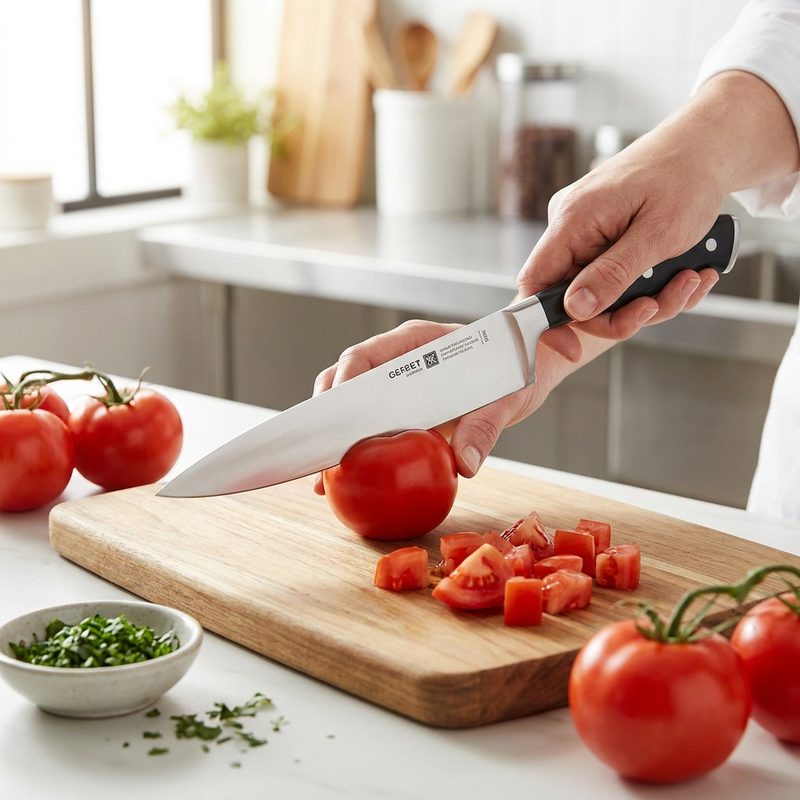
Step 1: Choose Your Tools
The secret to a clean dice is using the right knife. For tomatoes, a sharp serrated knife (such as a 6-inch bread knife) or a very sharp chef's knife (8- to 10-inch blade, freshly honed) is essential to pierce the skin without crushing the delicate flesh. A serrated knife is especially forgiving on under-ripe or very firm tomatoes because its teeth grab the skin and saw through cleanly; a chef's knife works best on ripe, soft fruit if it is razor-sharp. Avoid a dull blade: it will compress the tomato walls, releasing juice prematurely and turning the dice into a wet, ragged mess. Place the tomato on a stable cutting board — a wooden or plastic board with a damp paper towel underneath to prevent slipping. For extra stability, rest the tomato on its side and slice off a thin sliver from the bottom to create a flat, non-rocking base before you begin any other cut.
Step 2: Remove the Core
Place the tomato on the cutting board with the stem side facing up. Use the tip of your knife to cut a small circle around the stem (the core) at a 45-degree angle, about 1/2 inch deep, and pop it out with the tip. Alternatively, you can slice a thin layer (1/8 inch) off the top of the tomato to remove the stem entirely — this is faster but wastes a little flesh. If you feel resistance or the core is stubborn, do not force it; instead, angle the knife slightly outward to cut a cone shape around the stem. A missed core leaves a tough, greenish-white disc in the final dice that is unpleasant to bite into. If the tomato is very ripe and the core is soft, simply cut it out with a paring knife in a V-shape.
Step 3: Slice into Planks
Cut the tomato in half from the top to the bottom, through the core hole, using a single smooth sawing motion. Do not press straight down — that crushes the interior. Place each half flat-side down on the board to provide a stable base. Slice each half into vertical 'planks' of your desired thickness: for a small dice (1/4 inch), cut planks 1/4 inch thick; for a medium dice (1/2 inch), cut 1/2-inch planks; for a large dice (3/4 inch), cut 3/4-inch planks. Keep the knife blade parallel to the board and use your non-dominant hand's fingertips to guide the blade, with knuckles pressed against the blade flat for consistent thickness. If a plank wobbles or the tomato half slides, the cut will be uneven — re-trim the bottom flat if needed. You should see clean, straight edges with no torn skin or oozing seeds.
Step 4: Cut into Batons (Strips)
If you prefer a 'dry' dice (ideal for salads, salsas, or garnishes where excess liquid would water down the dish), this is the stage where you should use your thumb to gently scrape out the seeds and watery pulp from each plank. Run your thumb along the cut face of each plank, pushing the seed pockets outward — they will come out in gelatinous clumps. Alternatively, use a small spoon or the back of a paring knife. If you are making a sauce or a cooked dish where the juice is welcome, skip this step entirely. Once the pulp is removed (or kept, if preferred), stack 2-3 planks of equal thickness, aligning the edges carefully. Using a chef's knife with a rocking motion, cut the stack into long, even strips or 'batons' that match the thickness of the original planks (e.g., 1/4-inch planks become 1/4-inch batons). Keep your fingers curled under in a claw grip, with the knife blade sliding against your knuckles. If the stack shifts, press gently with your fingertips to realign; if the tomato is very soft, cut only one plank at a time to avoid squashing the lower layers.
Step 5: Execute the Final Dice
Turn the batons 90 degrees so they are perpendicular to the blade. Holding the strips together with your non-dominant hand (using the 'claw' grip to protect your fingertips), cut across the strips to create uniform cubes. Use a steady, rhythmic chopping motion — do not saw back and forth, as that will tear the skin and create ragged edges. The width of each cut should equal the baton thickness: for a 1/4-inch baton, cut every 1/4 inch. You should hear a clean, crisp sound as the blade passes through the tomato, not a wet squish. If the cubes stick to the blade, wipe it clean with a damp towel between cuts. Repeat with the remaining portions of the tomato, gathering the scraps (the end pieces and any uneven bits) for use in sauces or stocks. The final dice should be uniform cubes with intact skin on two or three faces and clean-cut flesh on the others; any crushed or torn pieces indicate the knife was dull or the pressure was too heavy. If you see uneven sizes, sort them by hand and re-cut the larger ones, or accept a rustic chop if precision is not critical.
Key Takeaways
- ✓ <html><ul><li><b>Use a Serrated Knife:</b> If your chef's knife isn't razor-sharp, a serrated bread or utility knife will saw through the skin effortlessly.</li><li><b>Skin-Side Down:</b> When dicing planks into strips, placing the skin-side down on the board can prevent the knife from slipping.</li><li><b>Keep it Cold:</b> If the tomato is very ripe and soft, refrigerate it for 20 minutes before cutting to help it hold its shape.</li><li><b>Save the Scraps:</b> Don't throw away the seeds and pulp; they can be added to stocks, soups, or vinaigrettes for extra flavor.</li></ul></html>