Butter Croissant

Indulge in the ultimate breakfast luxury with these artisan butter croissants, featuring hundreds of paper-thin, shatteringly crisp layers and a rich, tender interior. This recipe guides you through the classic laminating process to achieve bakery-quality results that melt in your mouth.
Prep
720m
Cook
20m
Serves
12
Ingredients
| Qty | Ingredient |
|---|---|
| 4 cups 500 g | All-purpose flour or T55 |
| 0.6 cup 140 ml | Whole milk, cold |
| 0.6 cup 140 ml | Water, cold |
| 0.25 cup 55 g | Granulated sugar |
| 3 tbsp 40 g | Unsalted butter, softened |
| 1 packet 11 g | Instant yeast |
| 2 tsp 12 g | Fine sea salt |
| 1.25 cups 280 g | European-style butter, cold (for lamination) |
| 1 large 50 g | Egg (for wash) |
How to Make Butter Croissant
Step 1. Mix the flour, sugar, yeast, and salt in a stand mixer. Add the cold milk, water, and 40g of softened butter, then knead for 5 minutes until a smooth dough forms.
Step 2. Shape the dough into a flat disk, wrap in plastic, and refrigerate for at least 2 hours or overnight.
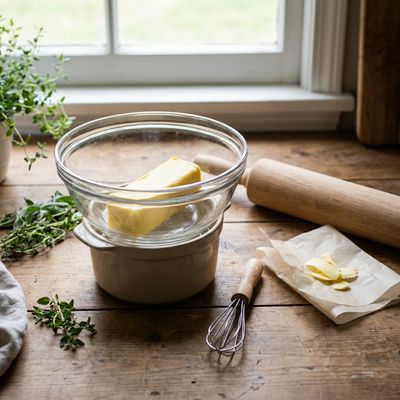
Step 3. Create the butter block by pounding the 280g of cold butter between two sheets of parchment paper into a 7-inch square. Chill until firm but pliable.
Step 4. Roll the chilled dough into a 10-inch square. Place the butter block diagonally in the center, fold the dough corners over the butter to seal it, and roll into a long rectangle.
Step 5. Perform the first 'letter fold' by folding the bottom third up and the top third down. Wrap and chill for 30 minutes. Repeat this rolling and folding process two more times for a total of three turns.
Step 6. Roll the finished dough to 4mm thickness and cut into tall triangles. Roll each triangle from the base to the tip to form the croissant shape.
Step 7. Place on a baking sheet and proof in a warm, draft-free spot for 2 hours until doubled in size and jiggly.
Step 8. Brush gently with egg wash and bake at 400°F (200°C) for 10 minutes, then lower to 375°F (190°C) for another 10-12 minutes until deep golden brown.
Chef's Tips
-
·
Use European-style butter with at least 82% fat content for better plasticity and flavor.
-
·
Ensure the dough and the butter block are the same consistency (pliable but cold) before laminating.
-
·
If the butter starts to melt at any point, immediately return the dough to the refrigerator.
-
·
Avoid over-proofing; the croissants should be airy and wobbly, but not collapsing.




Be the first to leave a comment.